




An AI system can be back online, its immediate problem fixed, and its incident ticket closed, while the organization remains vulnerable to the same failure.
Consider a hypothetical customer-support assistant that begins accessing information beyond its intended scope after a software integration changes. The engineering team rolls back the change and restores normal service. Customers can use the assistant again, and the immediate disruption is over.
But what caused the assistant to gain that access? Did the integration change expose a weakness in permissions, testing or approval? Could the same weakness affect another AI application? And who will check that the fix actually works?
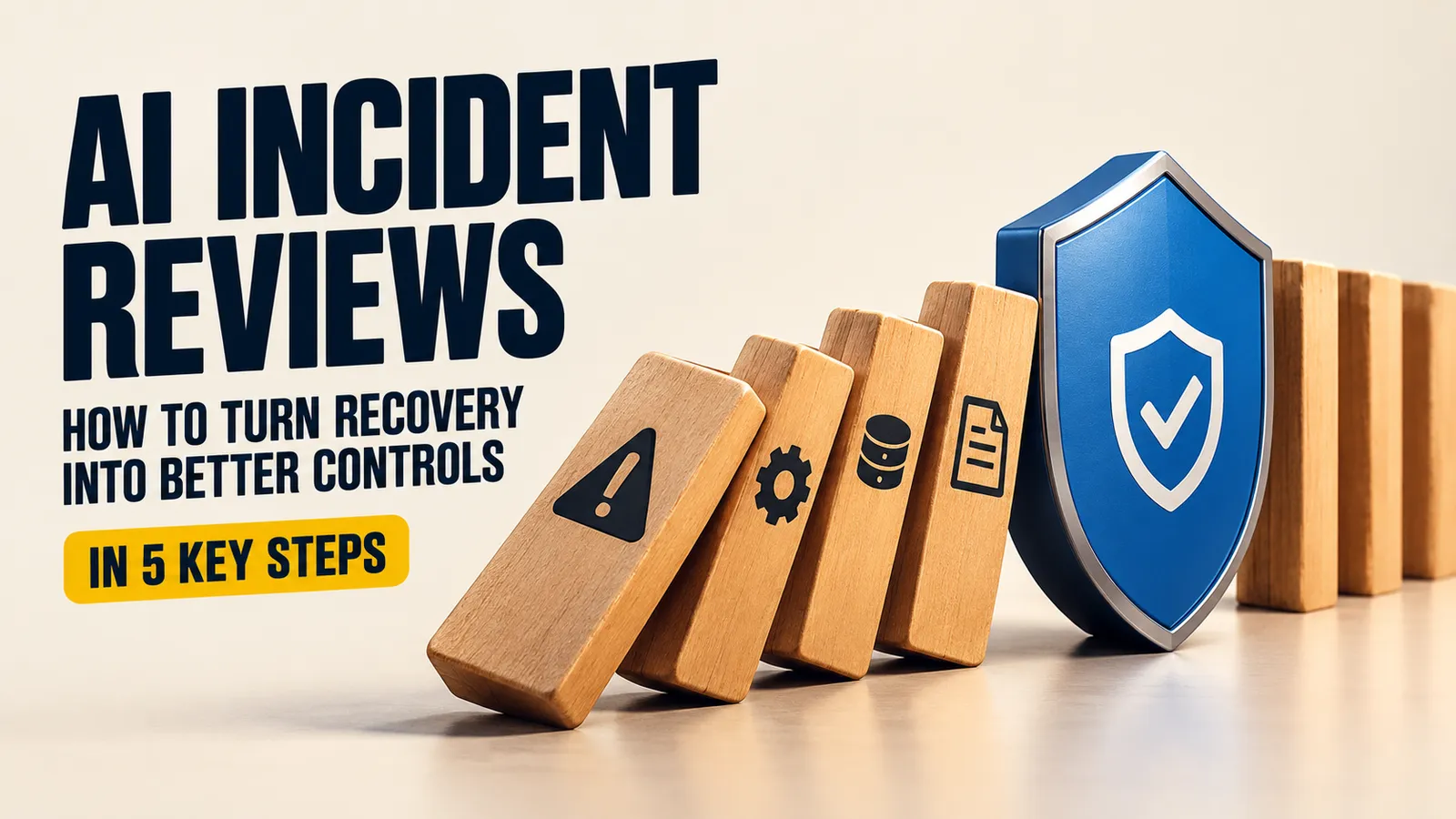
These are questions an AI incident review should answer. Restoring a service resolves an immediate operational problem. A proper review investigates why it happened, identifies what needs to change and establishes evidence that the corrective action has worked.
The distinction matters because the people responsible for restoring an AI system are not always the people responsible for preventing the next failure.
Closing an AI incident is not the same as learning from it
An engineering team may successfully roll back a release. An AI product owner may confirm that the application is functioning again. The business team may resume its normal workflow.Each is a legitimate part of recovery. None, by itself, establishes that the underlying risk has been addressed.
NIST's Computer Security Incident Handling Guide, updated in its third revision in 2025, places incident response within a wider risk-management process and emphasizes continuous improvement. The broader principle is relevant to AI incidents too: what an organization learns from an event should inform how it manages risk afterwards.
That requires more than writing a summary of what happened. An incident report can describe the symptoms accurately without establishing why they occurred, whether the same conditions exist elsewhere or whether the proposed fix is effective.
For organizations using AI in customer service, document processing, software development, financial operations or other business processes, that gap can be consequential. A system may recover while its permissions remain poorly understood, its evaluation tests miss the same failure mode, or its approval process still permits an unsafe change.
The real test of an AI incident investigation is whether it changes what the organization knows, decides or does.
Who is responsible after an AI system fails?
Responsibility is often spread across teams. That does not mean it should remain vague.The exact roles depend on how the organization operates, but a typical review may involve several people:
- The AI product owner or business process owner explains what the system was supposed to do, how the failure affected the business and what level of risk is acceptable.
- The engineering lead or MLOps/platform team investigates the technical cause, identifies the affected version or configuration, and tests the proposed fix.
- The AI risk or governance lead checks whether the incident changes the system's risk assessment, approval conditions or permitted use.
- The compliance or privacy lead assesses whether the event raises regulatory, contractual or personal-data obligations. Whether a notification is required depends on the facts and the applicable rules, not simply on the fact that an AI system failed.
- The system or control owner takes responsibility for implementing a corrective action, such as changing permissions, adding a test or revising an approval requirement.
- Internal audit or an independent reviewer, where appropriate, checks whether the evidence supports the conclusion that the issue has been addressed.
Without that distinction, an incident review can become a meeting in which everyone agrees that improvements are needed but nobody is accountable for completing them.
What should an AI incident review investigate?
A useful review connects the event to the conditions that made it possible. Five areas help establish whether the organization has learned enough to act.1. Establish what happened, and what remains uncertain
Start with the evidence available: relevant system logs, the affected model or application version, configuration changes, access records, evaluation results, user reports and the timeline of known events.Separate confirmed facts from plausible explanations. If the available evidence cannot establish exactly what the AI system did, record that limitation instead of presenting an assumption as a finding.
This is the foundation of reliable AI incident documentation. Without it, later decisions may rely on a simplified account of the event rather than what the evidence actually supports.
2. Find the contributing conditions, not just the visible error
A root cause analysis should go beyond identifying the last action before a failure.Perhaps a new integration introduced a permission the application did not previously have. The deeper issue might be that permissions were not reviewed when integrations changed, or that the release process did not test the assistant's access boundaries.
Those are different findings, and they lead to different corrective actions.
The review should distinguish the immediate trigger from contributing conditions and weaknesses in the controls around the system. It should also recognize when the evidence is insufficient to identify a single root cause.
The objective is not to find one person or one line of code to blame. It is to understand which conditions the organization can change to reduce the likelihood or impact of a recurrence.
3. Check whether the same weakness exists elsewhere
A problem found in one AI application may point to a broader weakness, but it does not automatically prove that every similar system is affected.The review should identify where the same component, integration, permission pattern, vendor dependency or release process is used. The relevant technical and business owners can then assess which other systems require investigation.
This is particularly important when an organization operates several AI applications across different teams. Fixing one deployment may leave the same underlying condition untouched in another.
The result should be a documented scope decision: which systems were checked, which were not, what evidence supports the conclusion and what uncertainty remains.
4. Turn findings into specific corrective actions
“Improve testing” is an intention, not a completed control.A useful corrective action identifies what will change, who owns the change, when it is due and what evidence will demonstrate completion.
Depending on the findings, the action could involve tightening permissions, adding a regression test, revising a release approval, updating an AI risk assessment or changing how vendor and model changes are reviewed.
The action must follow from the evidence. Adding a new approval step will not necessarily solve a technical permission problem, just as a code fix may not address a missing business decision.
The review should also record why the organization selected a particular response and who approved it. If the organization accepts some residual risk rather than eliminating it, that decision should be explicit and made by the appropriate authority.
5. Verify that the fix works
A corrective action is not effective simply because someone marks a task complete.The engineering team might demonstrate that a new permission restriction works in testing. The product owner might confirm that the intended business workflow still functions. The control owner might provide evidence that a revised approval process is now being followed.
The verification should match the problem being addressed.
Where practical, the organization should also consider whether the change introduced new problems or whether the original failure could recur under a different configuration. The reviewer should record the result and any remaining limitations.
This is the difference between recording an action and establishing that it improved the system.
What should an AI incident report contain?
A practical AI incident report should make it possible for someone who did not attend the review to understand what happened, what was decided and whether the organization followed through. Here's a list of records and what they should establish:- Incident and impact: What was observed, which business process was affected and what impact is confirmed.
- Timeline and evidence: What is known, which sources support it and where uncertainty remains.
- Affected system and version: Which model, application, integration or configuration was involved.
- Findings: The immediate trigger, contributing conditions and any unresolved questions.
- Scope assessment: Which related systems or workflows were considered and why.
- Decision and rationale: What the organization decided to change, accept or investigate further, and who approved it.
- Corrective actions: The specific changes required, their owners and target dates.
- Verification evidence: How the organization established whether each action worked.
- Residual risk and follow-up: What remains unresolved, who owns it and when it will be reviewed again.
Not every incident requires an elaborate report. The depth of the review should reflect the potential impact, the evidence available, the complexity of the system and the organization's established incident and risk procedures. A minor issue may need a short record and a verified fix. A consequential event may require a broader investigation and review by several functions.
The important point is consistency: the organization should be able to explain why the review was proportionate and show what it concluded.
What about AI near misses?
An AI near miss is an event in which a potentially harmful outcome was avoided, intercepted or did not materialize. It can reveal a weakness even when there is no confirmed harm.For example, a human reviewer might catch an AI-generated recommendation that relies on the wrong information before it reaches a customer. The absence of a harmful outcome does not establish that the system was operating safely. It means the immediate consequence was avoided.
A sensible AI near-miss reporting process captures the event, the conditions that produced it and the reason the outcome was prevented. The organization can then decide whether the event warrants a change to testing, permissions, review procedures or risk assessments.
It should not automatically classify every inaccurate AI response as a serious incident. The response should reflect the actual and potential impact, the system's intended use and the evidence available.
Near misses are useful because they can expose weaknesses before those weaknesses lead to a more consequential event. But that benefit exists only if reports are reviewed, relevant actions are assigned and the resulting changes are checked.
How can organizations know whether incident reviews are working?
Counting incident reports or corrective actions is not enough. A high number of reports might reflect better reporting rather than worse performance, while a low number might reflect under-reporting rather than fewer problems.More useful measures examine what happens after an event:
- Time to assign ownership: How long does it take for findings to have accountable owners?
- Corrective-action completion: Which actions have been completed by their agreed dates, and which remain overdue?
- Verification coverage: What proportion of completed corrective actions have evidence that they worked?
- Recurrence: Have similar failures occurred again, and were the relevant earlier findings addressed?
- Review of related systems: Were potentially affected applications assessed, or was the fix limited to the system where the problem first appeared?
- Outstanding uncertainty: Which conclusions still rely on incomplete evidence, and who is responsible for resolving that uncertainty?
Where continuous AI assurance fits
An incident review is one part of the wider work of governing AI over time. The organization also needs to maintain a reliable connection between changes to its systems, the evidence supporting its approvals, the decisions made by accountable people and the actions that follow.That connection becomes harder to maintain when information is spread across engineering tickets, risk registers, documents, approval records and separate business workflows. A corrective action may be completed in one system while the original risk assessment or approval record remains unchanged.
Continuous AI assurance can help organizations keep those records connected, make ownership visible and establish whether required follow-up has been completed. It does not replace technical investigation, incident response, expert judgment or any applicable reporting obligations. Those responsibilities remain with the people and functions authorized to carry them out.
For KlaritiQ, the relevant question is whether an organization can show what changed after an AI incident, why that change was approved, who was responsible and what evidence supports the conclusion that the corrective action worked.
Recovery is the beginning of the next decision
When an AI system returns to service, the immediate pressure may be to close the ticket and move on. The engineering team needs to restore reliable operation. The business needs to resume its work. The people responsible for risk and governance need to determine whether the event changes what the organization should permit, monitor, approve or verify.Those responsibilities should not be left to an undefined group called “the team.” They belong to identifiable people, including the engineering lead investigating the cause, the product or process owner assessing the business impact, the risk or compliance lead reviewing the implications, and the control owner responsible for making the agreed changes stick.
A useful AI incident review makes those responsibilities explicit and preserves the evidence needed to follow through.
Recovery tells you the service is working again. A good incident review establishes what will be different next time, who is responsible for making that difference, and how the organization will know the change worked.